

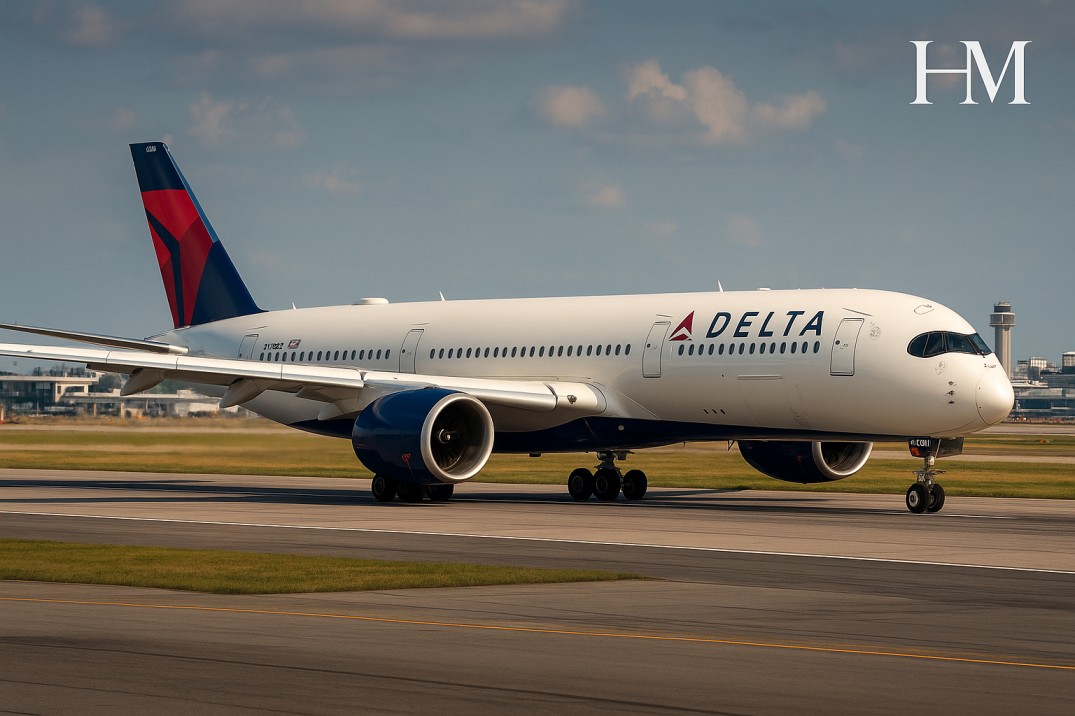
What Happened on May 28, 2025
Delta Flight DL275 Japan Diversion LAX: Delta Flight DL275 operating from Detroit Metropolitan Airport to Tokyo Haneda Airport was forced to make an emergency diversion to LAX on May 28, 2025, after experiencing a critical anti-ice system failure. The Airbus A350-900 (registration N508DN) was carrying 287 passengers when the incident occurred approximately 620 nautical miles southwest of Anchorage, Alaska, over the Bering Sea.
The flight departed Detroit at 1:07 PM EST on May 27, 2025, and was scheduled
🚨 DELTA FLIGHT DL275 🚨
EMERGENCY DIVERSION
📅 May 28, 2025
🛫 Detroit → 🛬 LAX
⚠️ Anti-Ice System Failure
Airbus A350-900 | 38,000 feet altitude
for a 13-hour journey across the Pacific. However, roughly 5 hours into the flight, the crew detected a complete failure of the anti-ice system in one of the aircraft’s Rolls-Royce Trent XWB engines.
The Technical Problem Explained
The anti-ice system failure was the critical issue that triggered the Delta Flight DL275 Japan diversion LAX. This system uses heated bleed air (temperatures between 400-600°F) from the engine’s compressor to prevent ice formation on vital engine components like fan blades and inlet guide vanes.
At cruise altitude of 38,000 feet (FL380), outside temperatures plummet to -67°F (-55°C). Without a functioning anti-ice system, ice can accumulate rapidly on engine surfaces, potentially causing:
- Reduced engine performance
- Abnormal vibrations
- Airflow disruption
- Complete engine failure in worst-case scenarios
The aircraft’s Engine Health Monitoring (EHM) system detected several warning signs:
- Low anti-ice airflow rate
- Decreased oil pressure
- Increased vibration levels
Why Diversion Was Necessary
Although the Airbus A350 can safely fly with one compromised engine system, continuing across the remote Pacific Ocean would have been extremely risky. The crew faced a critical decision point: continue 4 more hours over open water with no emergency landing options, or divert to the nearest suitable airport.
International aviation safety regulations mandate that aircraft cannot continue over remote oceanic routes with critical system failures. The pilots chose safety over schedule and initiated the Delta Flight DL275 Japan diversion LAX protocol.
Why LAX Was Selected
Los Angeles International Airport was chosen as the diversion point for several strategic reasons:
Technical Capabilities: LAX has Delta TechOps facilities with Airbus A350 specialists and Rolls-Royce engine experts on-site, enabling immediate diagnosis and repair.
Infrastructure: The airport features four long runways capable of handling heavy wide-body aircraft, with Runway 06R specifically equipped for international diversions.
Hub Status: As a major Delta hub, LAX offered immediate passenger support services, including rebooking capabilities and accommodation arrangements.
Customs & Immigration: The airport can efficiently process 287 international passengers arriving unexpectedly from an aborted transpacific flight.
Flight Timeline
May 27, 2025 – 1:07 PM EST: Flight departed Detroit gate A46
Approximately 6:00 PM EST: While cruising over the Bering Sea, crew detected the anti-ice system failure
6:00 PM – 6:45 PM EST: Crew assessed the situation, declared emergency, and coordinated with Air Traffic Control
Next 5 hours: Aircraft flew southward toward California
May 28, 2025 – 1:08 AM PST (1:38 AM PDT): Safe landing at LAX Runway 06R after 12 hours and 15 minutes total flight time
Financial Impact
The Delta Flight DL275 Japan diversion LAX incident carried substantial costs:
Direct Operating Costs: Approximately $180,000 in extra fuel for the 5-hour diversion route
Aircraft Ground Time: The plane remained at LAX for 18.5 hours undergoing inspection and repairs
Revenue Loss: The Tokyo leg was cancelled, costing Delta an estimated $2.3 million in lost revenue within 72 hours
Total Estimated Cost: Between $5.9 million when factoring in passenger compensation, hotel accommodations, rebooking expenses, and maintenance
Passenger Experience
All 287 passengers landed safely with no injuries reported. According to passenger accounts, the crew maintained professional communication throughout the incident.
David Park, a business consultant in seat 12A, noted that passengers were kept informed about the technical issue and the decision to divert for safety reasons.
Delta’s passenger support included:
- Hotel vouchers for overnight stays
- Meal allowances
- Priority rebooking on alternative flights to Tokyo
- Clear communication about compensation options
Most passengers were rebooked within 24-48 hours on subsequent flights to Tokyo Haneda, though some faced multi-day delays depending on seat availability.
Safety Response
The incident demonstrated textbook aviation safety protocols. No passengers were in immediate danger at any point, as modern aircraft like the Airbus A350 feature multiple redundant systems.
The flight crew’s decision to execute the Delta Flight DL275 Japan diversion LAX was a precautionary measure required by FAA regulations and international aviation standards. Pilots are specifically trained for these scenarios, and the crew followed established emergency procedures perfectly.
Emergency services at LAX were on standby during landing, though their intervention was not required. The landing itself was routine, with no unusual circumstances beyond the unscheduled arrival.
Investigation and Prevention
Rolls-Royce and Delta Air Lines launched a joint investigation into the anti-ice system failure. Initial findings suggest that predictive maintenance technology might have detected early warning signs before departure.
Engine Health Monitoring (EHM) systems collect real-time data during every flight, and advanced AI-powered predictive analytics are increasingly capable of identifying component degradation before failures occur.
Industry experts estimate that implementing comprehensive predictive maintenance could reduce similar incidents by up to 95%. Delta TechOps has expanded its partnership with Airbus Skywise and aerospace data analytics platforms to enhance early detection capabilities.
Aviation Industry Context
Flight diversions like the Delta Flight DL275 Japan diversion LAX are relatively uncommon but not unprecedented. The aviation industry experiences an estimated $8.3 billion annually in diversion-related costs across all carriers.
On the same day as the DL275 incident, two other Delta flights also diverted:
- Flight DL2346 (LaGuardia to Miami) diverted to JFK after a loud noise during takeoff
- Flight DL2286 (JFK to Atlanta) diverted to Charlotte due to cockpit smoke detection
While these incidents were unrelated, they highlight the aviation industry’s commitment to safety-first decision-making.
Current Flight Status
Delta Flight DL275 continues to operate daily between Detroit and Tokyo Haneda. The specific aircraft involved (N508DN) returned to service after completing all required inspections and repairs.
Delta Air Lines has implemented additional monitoring protocols for its Airbus A350 fleet, with enhanced focus on engine anti-ice systems during pre-flight checks and routine maintenance.
Conclusion
The Delta Flight DL275 Japan diversion LAX on May 28, 2025, stands as a testament to modern aviation safety. While the anti-ice system failure created operational challenges and significant costs, the crew’s decisive action ensured all 287 passengers reached the ground safely.
The incident reinforces several critical aviation principles: safety always trumps schedule, comprehensive crew training saves lives, redundant systems provide crucial backup protection, and predictive maintenance technology continues advancing to prevent future incidents.
For passengers affected by the Delta Flight DL275 Japan diversion LAX, the experience was certainly inconvenient, but it demonstrated why commercial aviation remains one of the world’s safest forms of transportation.
